
The answer to Rehmannia vs foxglove is no: Chinese foxglove usually refers to Rehmannia glutinosa, not to a species in the genus Digitalis. True foxgloves include Digitalis purpurea and Digitalis lanata. These plants belong to different genera and families.
The shared word «foxglove» is a common-name problem, not proof of botanical equivalence. HerbEra treats that word as a prompt to verify the Latin genus, not as proof of ingredient identity.
This distinction matters when checking a supplement, loose herb, extract, garden plant, or imported ingredient. True Digitalis plants contain toxic cardiac glycosides and are not suitable for unsupervised ingestion. Rehmannia products should identify Rehmannia glutinosa, the plant part, and the processing form.
Is Chinese foxglove a true Digitalis foxglove?
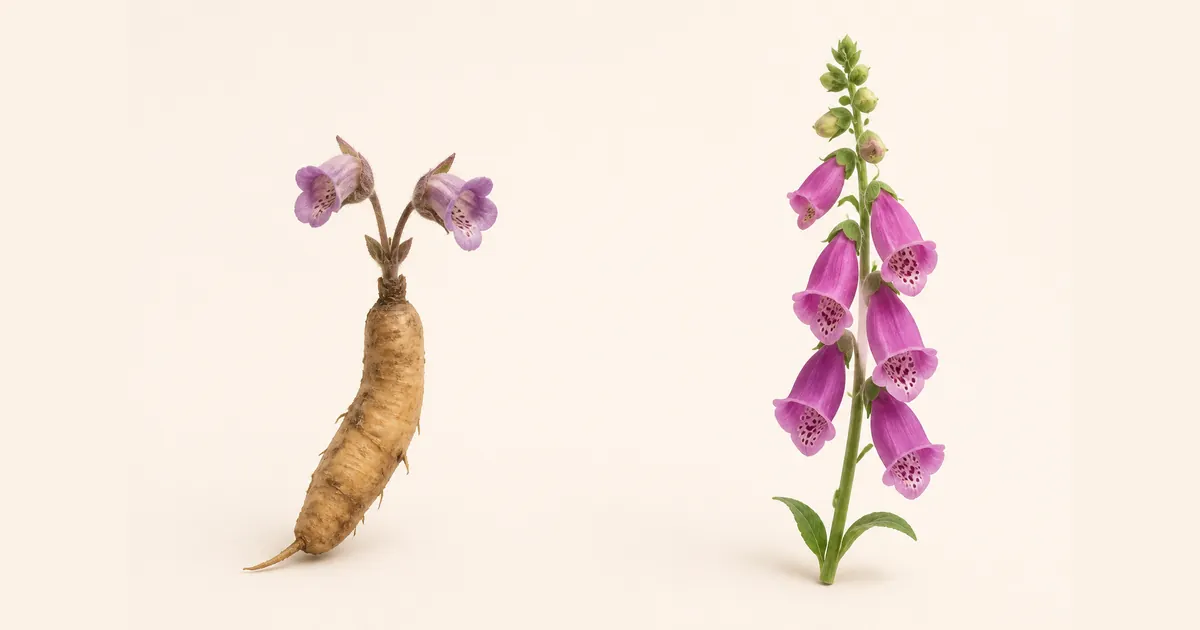
No. Chinese foxglove is a common name recorded for Rehmannia glutinosa. True foxglove is a general name for plants in the genus Digitalis.
The word «foxglove» does not create a taxonomic relationship at the genus level. It works like many other common names that compare one plant with the appearance of another.
| Identification field | Rehmannia | True foxglove |
|---|---|---|
| Typical scientific name | Rehmannia glutinosa | Digitalis purpurea or another Digitalis species |
| Genus | Rehmannia | Digitalis |
| Current family | Orobanchaceae | Plantaginaceae |
| Order | Lamiales | Lamiales |
| Common names | Rehmannia, Chinese foxglove, Di Huang | Foxglove, common foxglove, woolly foxglove |
| Relevant plant material | Root or root tuber | Leaves are historically associated with digitalis preparations, but all parts are poisonous if eaten |
| Consumer identification rule | Look for Rehmannia glutinosa | Look for the genus Digitalis |
The plants share the order Lamiales, but that does not make them interchangeable. An order contains many distinct plant families and genera.
Why is Rehmannia called Chinese foxglove?
The common name reflects the resemblance of its tubular flowers to foxglove flowers. Both plants produce showy, tube-shaped blossoms. Similar flower shape does not establish identical chemistry, genus, or ingredient status.
Common names describe rather than classify
A common name can refer to appearance, location, traditional usage, color, or resemblance. It does not follow the strict rules applied to scientific names. Different plants can therefore share part of the same common name.
Scientific names separate the plants
The first word in a botanical binomial is the genus. Rehmannia glutinosa belongs to Rehmannia. Digitalis purpurea and Digitalis lanata belong to Digitalis.
If the genera differ, the labels are not naming the same botanical species. This remains true even when both packages use the word «foxglove.»
Why does the historical name Digitalis glutinosa appear?
Digitalis glutinosa Gaertn. is a historical botanical name connected with the naming history of Rehmannia glutinosa. Current taxonomic systems place the species in Rehmannia, not in Digitalis.
A historical name does not make modern rehmannia root equivalent to common foxglove or woolly foxglove. Botanical classification changes when taxonomists revise relationships between plants.
Current accepted placement
Kew accepts Rehmannia glutinosa (Gaertn.) Libosch. ex DC. in Orobanchaceae. NCBI also places the species in the genus Rehmannia and records Chinese foxglove as a common name.
Current Digitalis placement
Kew accepts Digitalis as a separate genus in Plantaginaceae. The genus includes several true foxglove species. Common foxglove is Digitalis purpurea, while woolly foxglove is Digitalis lanata.
Does a Rehmannia label indicate Digitalis compounds?
No. The common name Chinese foxglove does not indicate that a product contains Digitalis, digoxin, digitoxin, or another named digitalis glycoside. Those identities require their own explicit declarations.
Do not use taxonomy alone to infer a complete chemical profile. The practical conclusion is narrower: a correctly identified Rehmannia glutinosa ingredient is not botanically a Digitalis ingredient.
A label earns a clear identity in HerbEra’s workflow only after the genus, species, and plant part agree. Common names remain supporting information.
Words that indicate Rehmannia
Look for Rehmannia glutinosa, Rehmanniae Radix, rehmannia root, Di Huang, Xian Di Huang, Sheng Di Huang, or Shu Di Huang. The Chinese names can also identify whether the root is fresh, dried unprepared, or prepared.
Words that indicate true foxglove
Look for Digitalis, Digitalis purpurea, Digitalis lanata, foxglove leaf, digitalis leaf, or another clearly named Digitalis species. Such wording requires a different level of caution from the common name Chinese foxglove.
Named substances are separate entries
Digoxin and digitoxin are named substances, not synonyms for rehmannia. A product containing either should declare it directly rather than relying on a botanical common name.
How can you distinguish the labels before buying?
Read the Latin name before relying on the front-panel common name. Then check the plant part and processing description. The word «foxglove» by itself is too broad for ingredient verification.
| Label wording | Likely identity | What to verify | Consumer action |
|---|---|---|---|
| Rehmannia glutinosa root | Rehmannia | Fresh, dried, or prepared root | Compare processing and product format |
| Chinese foxglove root | Usually rehmannia | Full Latin name | Confirm Rehmannia glutinosa |
| Rehmanniae Radix | Rehmannia root material | Processing form | Check for Xian, Sheng, or Shu Di Huang |
| Digitalis purpurea | Common foxglove | Product identity and intended regulated context | Do not handle it as an ordinary herbal supplement |
| Digitalis lanata | Woolly foxglove | Product identity and intended regulated context | Do not use it without qualified oversight |
| Foxglove leaf | Potentially a Digitalis ingredient | Genus and species | Pause until the identity is confirmed |
| Foxglove extract | Ambiguous and potentially high risk | Botanical binomial and plant part | Do not rely on the common name alone |
| Digoxin or digitoxin | Named cardiac glycoside | Exact product and professional directions | Do not interpret it as a rehmannia synonym |
Can flower appearance reliably identify the plant?
No. Flower shape can help with preliminary recognition, but it cannot replace botanical identification. Both genera can produce tubular flowers, which is one reason the common names overlap.
Rehmannia flower pattern
Rehmannia glutinosa is a perennial herb with tubular flowers that may appear reddish-purple. Commercial rehmannia ingredients usually feature the underground root material rather than the flowers.
Digitalis flower pattern
Digitalis purpurea commonly produces tall flower spikes with hanging, bell-like purple, pink, or white flowers. The inside of the flower often has spotted markings.
Limits of visual identification
Photographs can distort size, color, leaf arrangement, and surface detail. Processed roots, powders, capsules, and extracts cannot be identified from flower appearance because the flower is absent from the finished product.
Why does true Digitalis require special caution?
True foxglove plants contain toxic cardiac glycosides. MedlinePlus and Kew state that foxglove can be poisonous when plant material is eaten. This warning applies to leaves, flowers, stems, and seeds rather than only one visible part.
Do not taste an unknown plant or make a homemade foxglove preparation. If someone may have swallowed true foxglove, contact local emergency services or a poison information center immediately. Do not wait for signs of exposure before seeking case-specific guidance.
This safety warning does not mean that every product called Chinese foxglove contains Digitalis. It explains why the Latin genus must be checked before the common name is interpreted.
Rehmannia and Foxglove Label Checklist
Use this checklist when a product page or package includes the word «foxglove.» Work from the scientific name to the common name, not the other way around. Stop the comparison if the genus remains unclear.
Find the Latin genus
Look for Rehmannia or Digitalis. This is the fastest way to separate the two plants.
Confirm the species
Rehmannia products commonly identify Rehmannia glutinosa. True foxglove labels may identify Digitalis purpurea, Digitalis lanata, or another Digitalis species.
Check the plant part
Rehmannia supplements normally use root or root tuber. A reference to foxglove leaf points toward a different ingredient category.
Read the common name second
Use Chinese foxglove only as supporting information. Do not let it override the scientific name.
Identify the processing form
For rehmannia, check whether the root is fresh, dried unprepared, or prepared. Look for Xian, Sheng, or Shu Di Huang.
Separate plant names from substances
Do not interpret digoxin or digitoxin as alternative names for rehmannia. They require their own clear product declarations.
Reject incomplete identification
A label that says only «foxglove extract» does not provide enough information. Request the genus, species, and plant part.
Respond carefully to possible exposure
Contact an appropriate poison information service if true foxglove may have been swallowed. Avoid home experiments with unknown plant material.
FAQ
Is Chinese foxglove the same as Digitalis?
No. Chinese foxglove is a common name for Rehmannia glutinosa, which belongs to the genus Rehmannia.
Is Rehmannia a true foxglove?
No. True foxgloves belong to the genus Digitalis.
Are Rehmannia and Digitalis in the same family?
No. Kew places rehmannia in Orobanchaceae and Digitalis in Plantaginaceae.
Why do the flowers look similar?
Both plants produce tubular flowers. Visual resemblance likely contributed to the common name Chinese foxglove.
Does «Chinese foxglove» on a label mean digoxin?
No. The common name does not declare digoxin, digitoxin, or a Digitalis ingredient.
Which name confirms a rehmannia ingredient?
Look for Rehmannia glutinosa, preferably followed by root or root tuber.
Which name confirms true foxglove?
A scientific name beginning with Digitalis, such as Digitalis purpurea, identifies true foxglove.
What if a product says only «foxglove»?
Do not assume the identity. Ask for the full botanical name and plant part before using or comparing the product.
What should I do after possible true foxglove ingestion?
Contact local emergency services or a poison information center immediately for case-specific instructions.
Glossary
Chinese foxglove
A common name associated with Rehmannia glutinosa.
True foxglove
A plant belonging to the genus Digitalis.
Rehmannia glutinosa
The accepted botanical species commonly used as the source of rehmannia root.
Digitalis purpurea
The botanical name for common foxglove.
Digitalis lanata
The botanical name for woolly foxglove.
Botanical binomial
A two-part scientific name consisting of a genus and species.
Cardiac glycoside
A class of potent compounds associated with true foxglove and certain other plants.
Root tuber
A thickened underground root structure used as the main rehmannia material.
Common name
An informal plant name that may vary by region and does not establish exact taxonomy.
Conclusion
Chinese foxglove is Rehmannia glutinosa, not a true Digitalis foxglove. Check the Latin genus first, then confirm the species, plant part, and preparation before interpreting or comparing a product.
Sources Used
- Taxonomy record listing Chinese foxglove as a common name for Rehmannia glutinosa, NCBI Taxonomy — ncbi.nlm.nih.gov/Taxonomy/Browser
- Accepted taxonomic record for Rehmannia glutinosa in Orobanchaceae, Plants of the World Online — powo.science.kew.org/taxon/808644-1
- Accepted genus record for Digitalis in Plantaginaceae, Plants of the World Online — powo.science.kew.org/taxon/30112738-2
- Botanical profile and hazard information for Digitalis purpurea, Plants of the World Online — powo.science.kew.org/taxon/802077-1
- Consumer safety information about foxglove plant exposure, MedlinePlus Medical Encyclopedia — medlineplus.gov/ency/article/002878.htm
- Official description of Rehmannia glutinosa root material, Hong Kong Chinese Medicine Regulatory Office — cmro.gov.hk/html/eng/useful_information/gcmti/thematic_exhibitions/radix_rehmanniae/radix_rehmanniae.html